
Portal FAQs
Land Use & Development FAQs
Why is Transpower interested in Land Use & Development ?
Transpower has an interest in land use and development around the National Grid because it can impact the ability to operate the National Grid. The National Grid can also impact the use of your site. Pātai is one of the tools that Transpower uses to assist land developers implement their plans without causing negative effects on the National Grid or having the National Grid negatively impact their development.
The Resource Management Act recognises the National Grid as nationally significant infrastructure that must be sustainably managed and reverse sensitivity effects on National Grid avoided.
Land development and use must be managed to ensure the operation, maintenance, upgrading, and development of the National Grid is not compromised.
What is the risk?
Inappropriate land use and development presents a significant risk to the operation of the National Grid, which can result in electrical and physical hazards to property and people, as well as line faults or power outages that are costly to our communities.
Key risks of incompatible development and land use are:
- Harm to people and damage to property.
- Interruption to supply resulting in cost to business and communities.
- Access and maintenance of the assets.
What is a Sensitive Activity or Building?
A Sensitive Building includes new dwelling/s, minor dwellings, garage conversions, papakāinga, visitor accommodation, boarding houses, integrated residential development, retirement villages, supported residential care, schools and educational facilities, hospitals, healthcare facilities or care centres.
What is the National Grid Yard?
The National Grid Yard is the area beneath, and immediately next to, National Grid lines, including their support tower or pole structures.
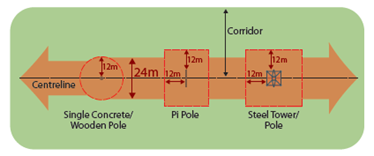
It is a 12m setback either side of the centreline of a National Grid line and 12m in any direction from the outer edge (foundation), of a National Grid line support structure - such as a tower leg foundation or pole and its support wire anchor point. The standard setback measured 12m either side of the transmission centreline (an imaginary line along the span from the middle of one tower or pole to the next), decreases to 10m where the line span is supported by a single pole. However, the setback from the pole remains the same at 12m.
What can I do in the National Grid Yard?
Transpower seeks to keep the National Grid Yard (NGY) free of buildings and structures and to manage land development and use that poses a potential risk to people’s safety or to the safety of the National Grid. What can and cannot be established within the NGY depends on where National Grid assets are located on or near the site. Existing activities within the NGY may be subject to existing use rights. You may want to seek guidance from a Councils planning team or a consultant planner to understand if these rights apply to your site.
Transpower will not support any new or extended sensitive activities within the NGY. It is often possible to design around National Grid transmission lines or use the land within the NGY for other compatible purposes. Check the design guide for ideas.
If you want to establish a new building or structure, subdivide, or alter land use within the National Grid Corridor or NGY, please contact Transpower to discuss your proposal as soon as possible. If you are unsure what you can and cannot do, providing Transpower concept sketches in your initial enquiry may be a useful way of understanding how these restrictions apply to the site before investing in expensive technical drawings.
What is a Subdivision Corridor?
The National Grid Subdivision Corridor is the area where Transpower needs to be involved in the design and layout of a subdivision to ensure future uses of the lots created by the subdivision are suitable for the intended land use. For example, you do not want to create a residential lot where the house on that site will not meet the safe separation requirements from overhead lines.
The National Grid Subdivision Corridor varies between different Council’s District Plans but is usually an area up to 39m either side of the centreline of a transmission line. The size of the corridor differs depending on the voltage and type of support structure and how much the lines will deflect or “blow out” to the sides in high wind situations.
In the Auckland Unitary Plan, the National Grid Subdivision Corridor has varying widths depending on the maximum “blowout,” or swing, of the conductors (“wires”) on each individual line span (the distance between the support towers or poles).
What can I do in the National Grid Subdivision Corridor?
Subdivision is an opportunity to design new development in a manner that takes the lines into account – including ensuring lots are of a size that is adequate to accommodate the intended future use and buildings. A number of activities, including residential buildings, can occur within the Subdivision Corridor, provided they are set back outside the National Grid Yard and access to towers and poles is not blocked.
What is NZECP34:2001?
The New Zealand Electrical Code of Practice for Electrical Safe Distances [NZECP 34: 2001] commonly abbreviated as NZECP, is an electrical code of practice and regulation of the Electricity Act 1992. NZECP sets minimum safe separation distances for buildings/structures, earthworks, mobile plant and people from transmission lines and support structures. These minimum safe distances have been set primarily to protect persons, property, vehicles and mobile plant from harm or damage from electrical hazards.
Compliance with NZECP is mandatory (Regulation 93 of the Electricity Regulations 1997).
It is important to understand that NZECP is a control on land development and use in addition to resource management planning requirements set out by Council’s District Plans and the Resource Management Act. Compliance with NZECP does not mean compliance with District Plan rules or that there are no adverse effects on Transpower’s assets. NZECP does not consider the operational, maintenance, access and upgrading requirements of the National Grid.
Reverse sensitivity and amenity effects are not within the scope of matters controlled by NZECP 34 and such effects are managed as part of the National Grid Yard requirements described above.
What is the National Policy Statement on Electricity Transmission 2008 (NPSET)?
The NPSET is a National Policy Statement providing direction for local authorities (Councils) on how to recognise and provide for the national significance of the National Grid in planning documents and decision-making under the Resource Management Act 1991. These documents include regional policy statements, regional plans, and district plans.
The Objective of the NPSET is:
“To recognise the national significance of the electricity transmission network by facilitating the operation, maintenance and upgrade of the existing transmission network and the establishment of new transmission resources to meet the needs of present and future generations, while:
- Managing the adverse environmental effects of the network; and
- Managing the adverse effects of other activities on the network.”
What is the difference between the setbacks in NZECP and the National Grid Yard setback?
The National Grid Yard (in line with Policy 11 of the National Policy Statement on Electricity Transmission 2008 [NPSET]) is a trigger to consider the operation, maintenance and upgrading requirements of the National Grid, as well as reverse sensitivity and amenity issues. NZECP addresses safe separation distances only. The National Grid Yard and NZECP setbacks can overlap, however they are independent of each other, and development and land use must comply with both.
I am looking to purchase a property that has transmission lines on/near it.
For pre-purchase enquiries, please contact the Council in the first instance. Although National Grid transmission lines are Transpower assets, the rules applying to them are Council rules within their District Plans. The Council’s duty planner will be able to advise what National Grid rules within their District Plan apply to your site and proposal, including whether a resource consent is required.
Council LIMs and transmission lines.
Please contact the Council in the first instance and ask them to explain the overlay and its requirements. Although National Grid transmission lines are Transpower assets, the rules applying to them are Council rules within their District Plans. The Council’s planning team or a consultant planner will be able to advise you on how the National Grid rules in the relevant District Plan apply to your site and the proposed activity, including if a resource consent is required.
Electricity (Hazards from Trees) Regulations 2003
The Electricity (Hazards from Trees) Regulations 2003 (referred to as the Tree Regulations) protect the security of supply of electricity, and the safety of the public, from hazards from trees. It prescribes distances from electrical conductors within which trees must not encroach, setting rules about who has responsibility for cutting or trimming trees that encroach on electrical conductors, and assigning liability if for breach of the rules. All trees growing near high voltage transmission lines require management to comply with the regulations. The Tree Regulations apply better to forestry than planting associated with creating amenity and recreation spaces as part of a residential subdivision. The effects of planting near transmission lines will is more effectively managed through the resource consent process.
Where can I find further information?
You can find further information here: